
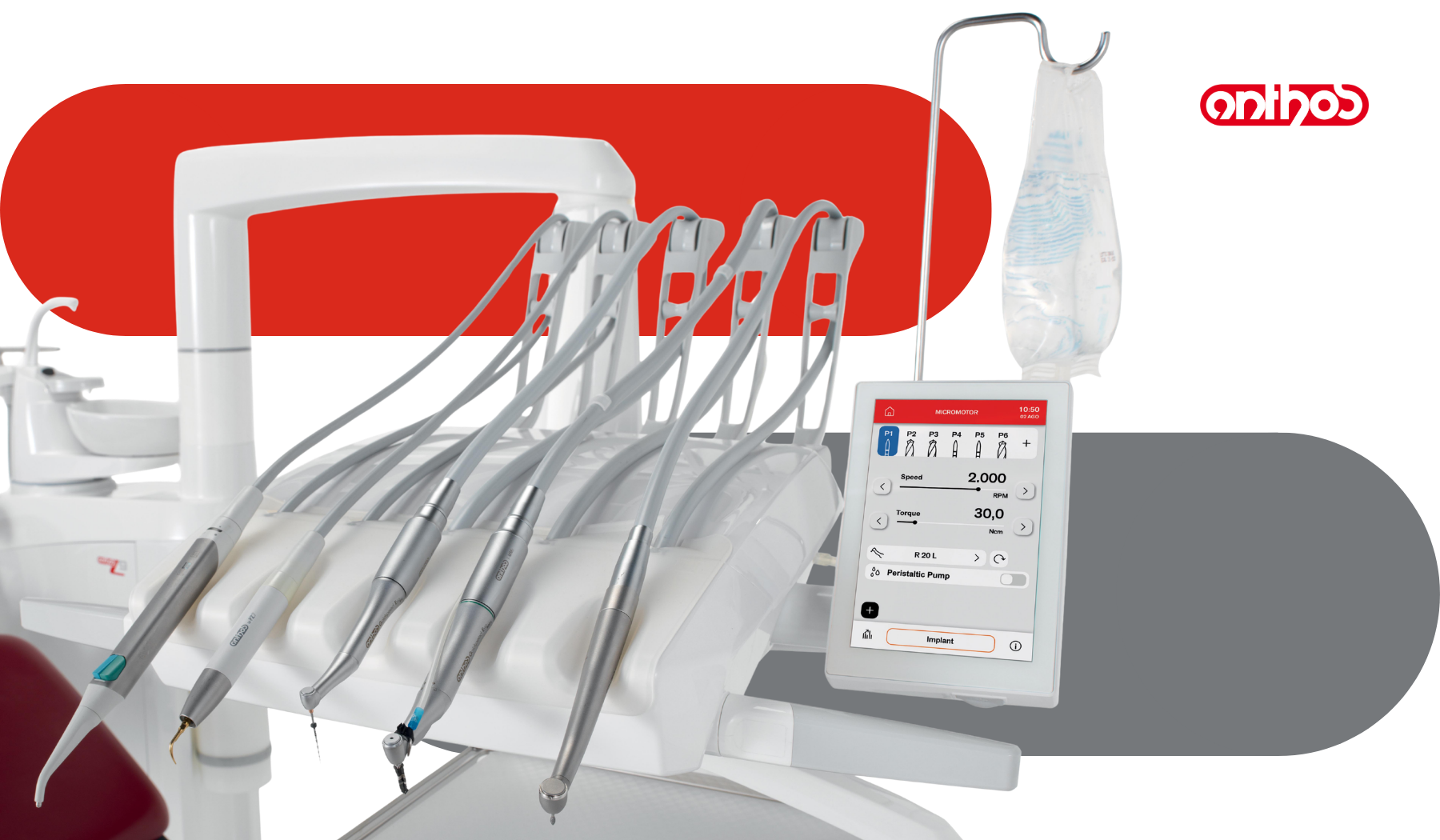
Implant therapy now plays a central role in clinical dentistry. Growing patient demands and advances in surgical techniques call for equipment that is increasingly reliable, precise and seamlessly integrated into the daily routine.
Anthos, a leading brand in the dental unit sector, offers an implant system that is fully integrated into the dental unit, designed to effectively meet the needs of the modern dentist.
Overcoming the problems of fragmented instruments and systems
Traditionally, in-practice implantology has required the use of additional equipment: bench-top micromotors, trolleys, power cables and dedicated foot controls. Whilst functional, this approach introduces critical variables in the management of the operating space and clinical time: floor space taken up, the need to reposition the patient or instruments, and electrical connections to manage.
Anthos has tackled this problem at its root by integrating its implantology system directly into the design of the dental unit, eliminating these disruptive elements and providing the dentist with a tidy and manageable operating environment.
The i-MMs micromotor: performance and versatility
At the heart of the system is the i-MMs micromotor, designed to deliver high performance throughout all stages of implant surgery. With a torque output of up to 70 Ncm, when used with the appropriate contra-angle, and precise speed control, the device adapts effectively to a range of clinical situations, from implant site preparation to implant placement.
The i-MMs micromotor is also a versatile instrument, suitable for endodontic and restorative treatments as well as implantology. This approach significantly reduces investment in equipment and the space required on the dentist’s module, optimising the management of practice resources.
Monitoring, hygiene and documentation: pillars of the system
The Anthos implant system has been designed around four key aspects, which define its clinical and operational value.
Convenience - the versatility of the i-MMs micromotor means that implant, endodontic and restorative treatments can all be carried out using a single instrument.
Intuitive operation – the Full Touch user interface is easy to configure and incorporates the familiar gestures of modern smartphones. Every practitioner can set up their own implant procedure using clear visual cues and customisable parameter presets, reducing preparation time and minimising the margin for error during treatment.
Hygiene - the system ensures the highest level of asepsis: the micromotor and contra-angle are autoclavable, and the cooling fluid is sterile and supplied by an integrated peristaltic pump controlled directly via the dental unit. The main operating settings can be accessed using the foot control joystick, thereby avoiding contact with non-sterile surfaces.
Documentation - the system records the torque values (using the software’s Torque Curves function) applied throughout the entire implant procedure. This provides documentation of high clinical value, which can be used for patient records, long-term monitoring and presentation in academic or training contexts.
One pedal for everything: the philosophy of unified control
One of the most appreciated features in the clinic is the foot-controlled operation of the systems. The Anthos implant system uses only the dental unit’s foot control, eliminating the need for an additional dedicated foot pedal.
This means less clutter on the floor, fewer distractions during procedures, and a more natural and fluid management of the treatment session. Similarly, integration into the dental unit eliminates the need for any trolley or mobile unit to be brought up to the chair: the micromotor is already there, ready for use, with no cables to connect and no time wasted on set-up.
Integration as a winning philosophy
Anthos’ integrated implantology system represents a significant step forward in the way we approach the dental operating environment. It is not merely an additional device, but a reimagining of the workflow: more organised, safer and more efficient.
For dentists who regularly perform implant procedures, the benefits are immediate: fewer interruptions, greater control, high hygiene standards and, with the Torque Curves, the ability to precisely track every procedure. For the practice, it is a sensible investment that brings together multiple functions within a single, effective and efficient instrument ecosystem.
.png?width=352&name=Mocom%20-%20Blog%20(15).png)
.png?width=352&name=Anthos%20-%20Blog%20(1).png)